Why do some people rush to try a new invention while others wait until almost everyone else has one? Curiosity plays a part, but so do trust, cost, habits, and the need for proof.
The diffusion of innovations theory explains the pattern new products, ideas, and trends tend to follow as they spread through a community. Understanding this pattern helps us recognize not only who adopts something first, but also what persuades everyone else to follow.
What Is the Diffusion of Innovations?
Sociologist Everett M. Rogers introduced the theory in 1962. He described diffusion as the process through which an innovation spreads over time, through different communication channels, within a community.
The central idea is simple: people do not all adopt something new at the same time or for the same reasons. Rogers grouped them into five adopter categories, from the first experimenters to the last holdouts.
The adoption curve shows these groups as sections of a bell-shaped curve. A small group moves first, the larger middle groups follow, and the final group adopts much later. As these groups join in, the total share of people who have adopted the innovation rises.
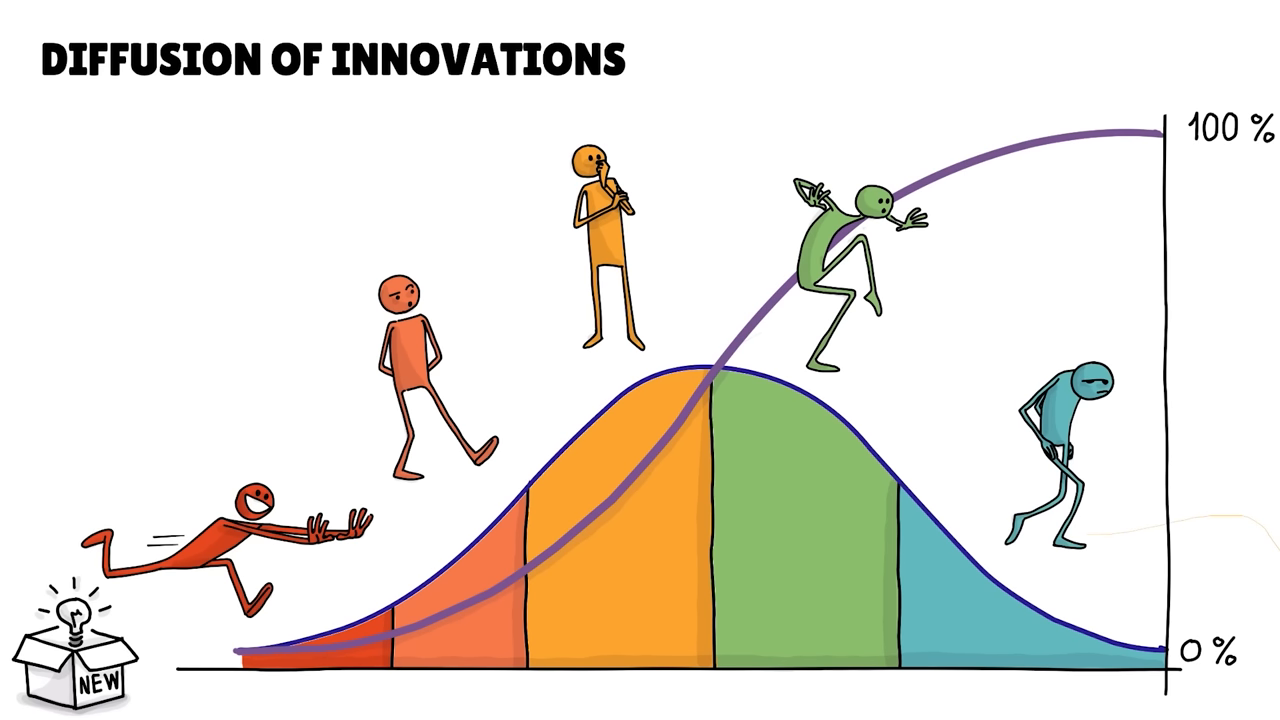
The Five Adopter Categories
Cell phones provide an easy way to picture the differences. The prices and dates below illustrate the journey from an expensive novelty to an everyday purchase, rather than fixed milestones for every buyer.
1. Innovators: The First to Experiment
Innovators make up about 2.5% of adopters. They are curious, enjoy trying unfamiliar things, and are willing to take risks. Often, they also have the financial resources to absorb the cost if an experiment disappoints.
Think of someone willing to spend around $4,000 on a cell phone in 1983. For an innovator, the opportunity to explore a new technology can outweigh its high price and uncertainty.
2. Early Adopters: The Trusted Opinion Leaders
Early adopters account for about 13.5%. They follow the innovators, but their enthusiasm comes with careful consideration. They assess something new before committing to it.
They are also respected by others. Once convinced, they share their experience and advice, helping an unfamiliar innovation become something people can trust. In the cell phone example, imagine an early adopter buying a roughly $1,000 phone by 1996, then telling others why it is useful.
3. Early Majority: Show Us That It Works
The early majority represents about 34%. These people are open to innovation, but they want real-world evidence before making a move. They wait for early adopters to pave the way.
Their question is less about whether something is exciting and more about whether it has proved worthwhile. Picture someone picking up a $300 cell phone around the turn of the century, after others have demonstrated its benefits.
4. Late Majority: Cautious Until It Becomes Common
The late majority also makes up about 34%. These adopters are skeptical, cautious, and often more attached to traditional ways of doing things.
They generally wait until most people have embraced an innovation before joining them. In our example, they buy a $100 cell phone in 2008, when using one is already well established.
5. Laggards: The Last to Adopt
Laggards account for the final 16%. They rely heavily on familiar methods and may adopt an innovation only when avoiding it becomes difficult.
That delay can reflect an aversion to change, but it can also reflect a lack of resources. Being last is not always simply a matter of refusing something new. Sometimes the practical barriers are greater.
What Makes an Innovation Easier to Adopt?
Adoption depends on more than a person's willingness to experiment. Rogers identified five characteristics people evaluate when deciding whether an innovation belongs in their lives:
- Compatibility: Does it fit our existing values, habits, and ways of doing things?
- Trialability: Can we try it before committing to it?
- Relative advantage: Is it actually better than the options we already have?
- Observability: Can we see its benefits?
- Complexity: How difficult is it to understand and use?
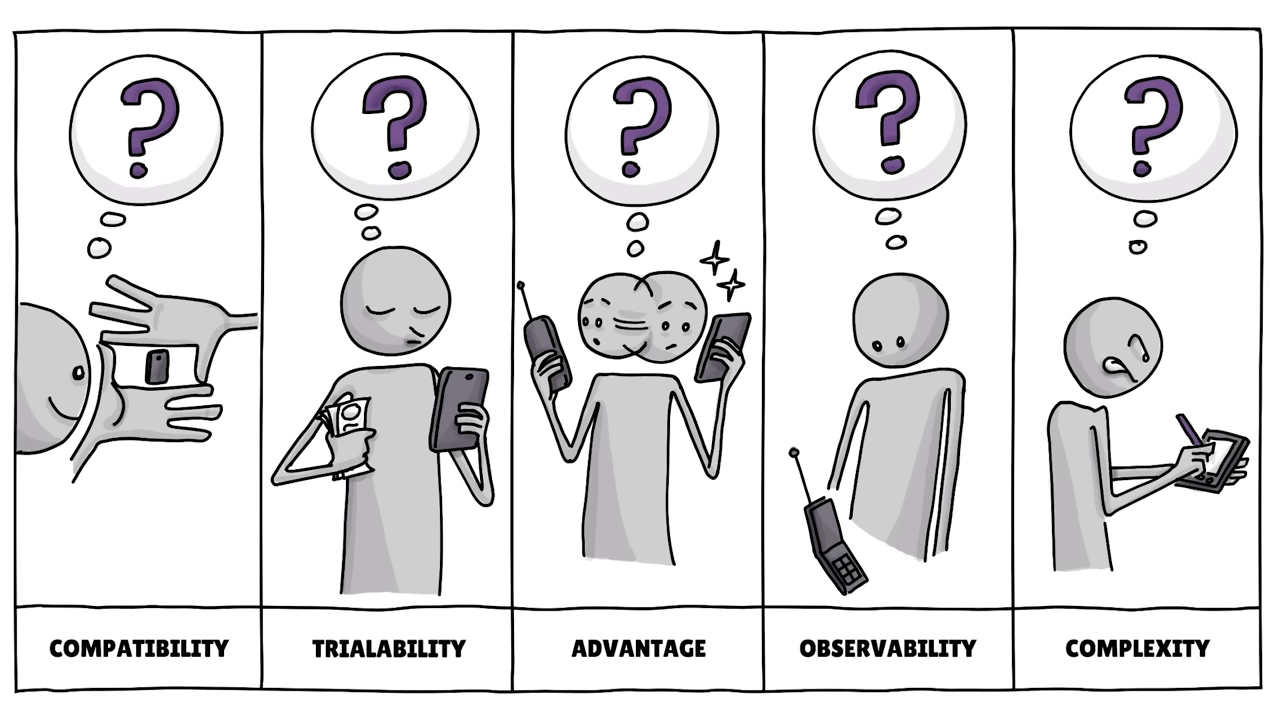
Imagine a product that clashes with familiar habits, is complicated to use, and cannot be tested before purchase. Each of those characteristics creates a reason to hesitate.
Yet a powerful advantage can still attract innovators. If the product offers something substantially better than existing alternatives, they may accept its drawbacks. Early adopters can then assess its value and spread the word.
These five characteristics help explain why technical improvement alone is not enough. A new invention may be better in one respect while remaining difficult to fit into everyday life.
How Communication and Cost Help Ideas Spread
Information has to travel before an innovation can spread. Research highlighted by Nicholas Felton suggests that faster communication allows innovators and early adopters to share new discoveries with others more quickly.
But hearing about something is not the same as being able to afford it. Falling prices can open adoption to a much larger group. As production expands, costs often decline. Solar cells illustrate this relationship between increasing production, lower prices, and wider access.
The cell phone example follows the same broad logic: what begins as a costly experiment becomes a more accessible purchase. Communication helps people learn about the benefits, while affordability makes acting on that knowledge possible.
Still, success is not automatic. Rogers emphasized that persuading people to adopt a new idea can be difficult even when its advantages seem obvious. The diffusion of innovations framework helps explain that difficulty rather than making it disappear.
Where Do You Fit on the Adoption Curve?
Are you eager to experiment, persuaded by trusted early adopters, or more comfortable waiting for widespread acceptance?
The useful question is not only how early you act, but what you need before you act: a clear advantage, a chance to try something, visible results, an easier experience, or a lower price.
And the question reaches beyond products. Could the same pattern help explain how ideas, beliefs, or social movements spread? It offers a starting point: look at who moves first, how others learn about the change, and what makes joining feel worthwhile.
|