A house, a bar of gold, and a share in a business are very different things. Yet over the long run, their prices in dollars have often moved in the same direction: up. Bitcoin, despite its dramatic swings and much shorter history, has also risen alongside an expanding money supply.
Does that mean everything is becoming more valuable, or that each dollar is buying less?
The answer matters because holding money and holding wealth are not necessarily the same thing. To understand why, we need to look at who creates money, why the supply expands, and who benefits when new money enters the economy.
Why Money Can Lose Its Value
Imagine putting a stack of dollars into a piggy bank and leaving it untouched for decades. The number printed on the bills stays the same. What those bills can buy does not.
This is the difference between nominal value, the number of dollars you have, and purchasing power, the goods and services those dollars can buy. When prices rise, unchanged cash savings buy less.
An expanding money supply can contribute to this process. More money available for spending and investing can increase demand for goods, services, and assets. If their supply does not keep pace, prices can rise.
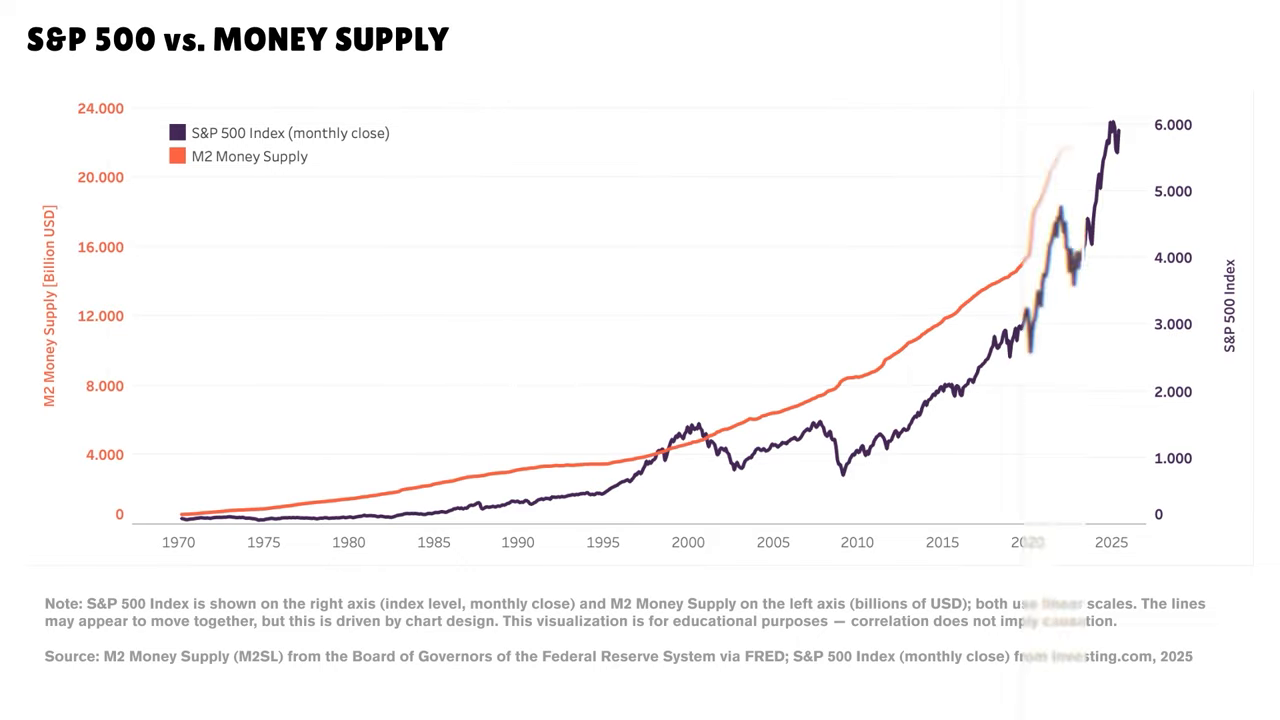
Long-term comparisons of money supply with gold, new home prices, the S&P 500, and bitcoin illustrate this relationship. The S&P 500 tracks shares in approximately 500 leading publicly traded American companies. Bitcoin comparisons often use a logarithmic scale to make large percentage changes easier to see.
But a useful distinction is essential: rising lines do not, by themselves, prove a single cause. Asset prices do not move in lockstep with money supply, and money creation is not a complete explanation for every price increase.
Definitions matter, too. Physical currency, bank deposits, central bank reserves, and total credit are not interchangeable measures of “money.” The Federal Reserve publishes commonly used money measures in its money stock statistics.
The Piggy Bank Versus Gold and Stocks
Suppose your grandparents generously set aside $10,000 for you in 1975. Consider three very different paths for that gift:
- Cash in a piggy bank: You would still have $10,000 roughly half a century later. Enough for a modest car, perhaps, but far less purchasing power than the original gift.
- Gold: An illustrative historical comparison puts the value of that original purchase at around $200,000 by early 2025. Now the car could be rather fancy.
- A fund tracking the S&P 500: A long-term calculation with reinvested dividends can put the result at roughly $2.8 million. That is a very different inheritance.
These are approximate historical illustrations, not promises. Exact results depend on purchase and sale dates, dividend reinvestment, fees, and taxes. Investments can fall in value along the way.
The important lesson is not that every asset always wins. It is that cash preserves its face value, while assets can participate in rising prices and economic growth. Leaving money untouched does not necessarily preserve what it can buy.
How Commercial Banks Create Money
Much of the money we use is not printed on paper. It exists as deposits in bank accounts. Commercial banks create new deposit money when they make loans.
The basic process looks like this:
- A bank approves a borrower’s loan application.
- It records the loan as an asset on its balance sheet.
- It credits the borrower’s account with a matching deposit.
- The borrower can spend that newly created deposit money.
No printing press required. A new account balance appears, alongside a new debt.
That does not mean banks can create unlimited money without consequences. Lending is constrained by regulation, capital, liquidity, risk, and the availability of creditworthy borrowers. A familiar explanation refers to a 10% reserve requirement, but that is not a current universal rule. In the United States, the Federal Reserve reduced reserve requirement ratios to zero in March 2020.
When a borrower repays the loan principal, the process reverses: the outstanding loan and corresponding deposit money shrink. In that sense, money created through lending can disappear again through repayment.
The Bank of England’s explanation of money creation in the modern economy provides a closer look at this mechanism.
Government Borrowing and Central Bank Money
Governments often spend more than they collect in revenue. To cover the difference, they borrow by issuing debt that investors, including fund managers and foreign investors, can purchase.
Government borrowing does not automatically create new money. Central banks have a separate role: they can create central bank money to buy financial assets, including government bonds, typically in secondary markets.
Large-scale asset purchases are often called quantitative easing. Rather than running a physical printing press, a central bank creates reserves electronically.
The scale can be enormous. During 2020, the Federal Reserve’s balance sheet expanded by roughly $3 trillion to $4 trillion, while the broad US money measure M2 rose by about a quarter. These are related developments, but they measure different things. Central bank reserves are not the same as spendable deposits held by households.
Why Expand the Money Supply at All?
The economic argument is straightforward: easier access to money and credit can encourage spending and investment. Businesses receive orders, projects move forward, and workers find jobs.
Government spending can direct funds toward projects, households, or particular groups. The intended chain is simple:
More spending supports demand, demand supports employment, and employment supports economic activity.
But even when activity increases, the benefits do not necessarily reach everyone equally. Who receives money, what it finances, and whether people already own assets all matter.
Who Gets Left Behind?
Three groups are especially exposed when prices rise:
- People holding idle cash. Their savings retain the same dollar amount while housing, shares, and other assets may become more expensive.
- People without access to investment markets. They may have money to save but limited opportunities to buy assets or participate in efficient capital markets.
- People earning too little to invest. After paying for everyday necessities, they have little or nothing left to purchase housing, gold, or stocks.
The last group can face a particularly painful double squeeze. Rent, food, and childcare costs may rise faster than paychecks. Meanwhile, the assets that could help build wealth move further out of reach.
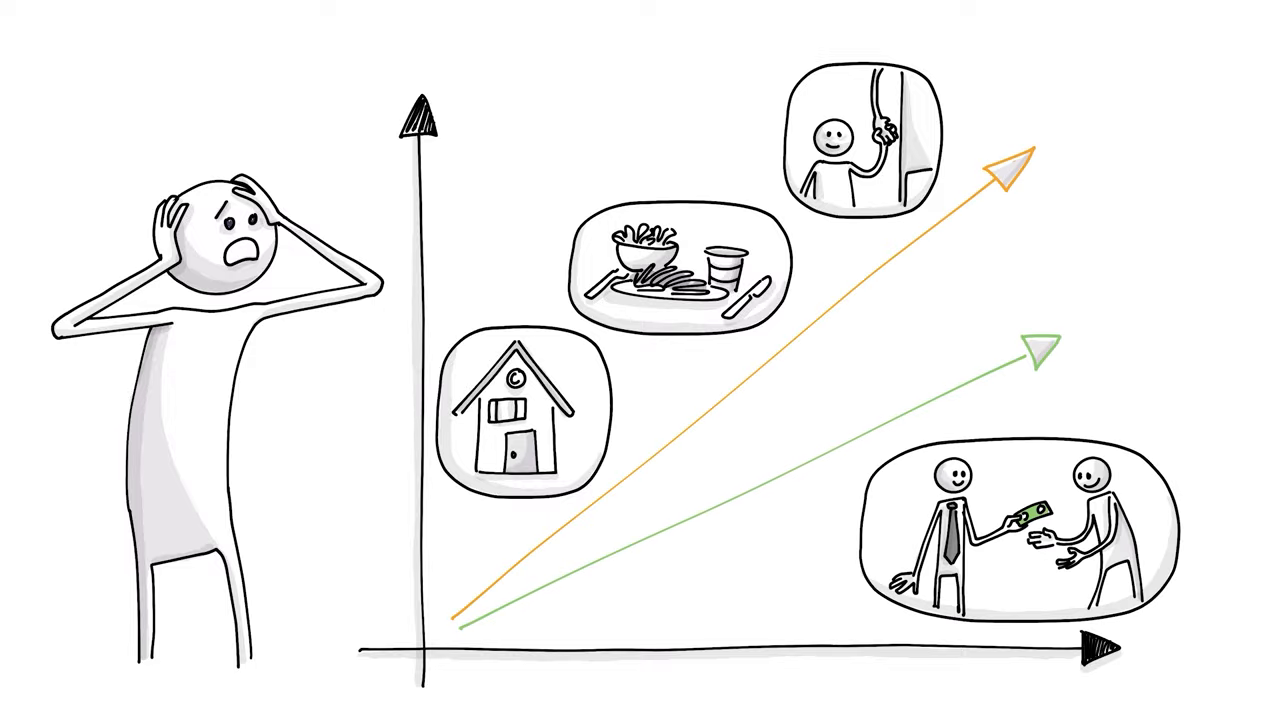
Someone who already owns assets may see their dollar-denominated wealth grow. Someone struggling to meet monthly expenses may find it harder even to get started. This is one way money creation and rising asset prices can contribute to wealth inequality.
Should We Simply Stop Creating Money?
Stopping money creation sounds like a simple answer. Yet lending creates money, repayment destroys it, and monetary policy is intended to support economic stability. The question is bigger than whether to switch off a printing press.
How can an economy support useful investment and employment without continually putting people who lack assets at a disadvantage? How can the benefits of growth become more accessible?
Understanding the system does not settle those questions. It does reveal why the balance in a bank account tells only part of the story. What matters is what that money can buy, and who has the opportunity to turn income into lasting wealth.
|