A bookshop separates fiction from nonfiction. Communication works along a similar spectrum, from colorful storytelling to plain statements of fact.
Both can teach us something. But they do different jobs. A story can make an idea feel alive, stir our emotions, and stay in our memory. A factual explanation can give us a definition, a framework, and a way to see beyond one particular experience.
Which is better for learning? To understand the difference, consider two ways of learning about tragedy: first a definition, then a story.
What Is a Tragedy? Start With the Definition
A tragedy is a dramatic work in which the main character experiences a downfall, often shaped by circumstances beyond their control.
Traditionally, tragedy aims to evoke catharsis: an emotional release through which painful feelings can produce a kind of satisfaction or pleasure. We experience suffering through the drama, yet find something meaningful in that experience.
This explanation gives us a category. It tells us what to look for and introduces a concept that we can apply to different works.
Now consider what happens when the same idea takes the form of a story.
Oedipus: When a Definition Becomes an Experience
A boy named Oedipus was born to the king and queen of Thebes. Soon after his birth, a prophet warned the king that the child would grow up to kill his father and marry his mother.
Determined to prevent this catastrophe, the king ordered a servant to kill the baby. But the servant could not bring himself to do it. Instead, he entrusted the child to a shepherd, who brought him to the king of Corinth. There, Oedipus was raised as the king’s own son.
Years later, a prophet told the grown Oedipus of his terrible destiny. Unaware that he had been adopted, he believed the warning concerned the parents who had raised him. To protect them, he left Corinth.
On the road to Thebes, Oedipus encountered an older man and his servants. A fight broke out, and Oedipus killed them.
When he reached Thebes, he found the city threatened by the Sphinx. Oedipus solved its riddle, and the creature killed itself. His victory made him a hero. The city named him its new king, and he married the queen, whose former husband had mysteriously been killed.
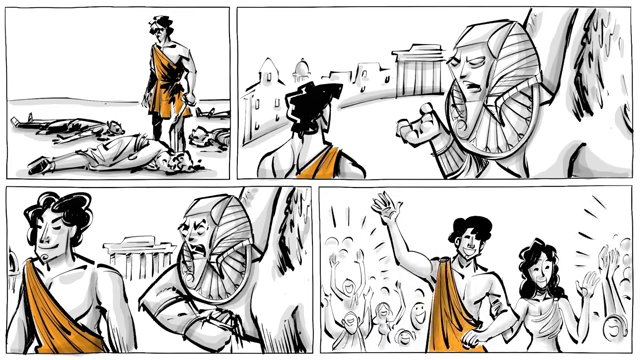
Oedipus and the queen had four children. Years passed. Then plague began to devastate Thebes.
Searching for an explanation, Oedipus learned that the city would remain doomed until the murderer of its former king was punished. He set out to find the culprit.
Gradually, his investigation revealed the truth. The man he had killed on the road was his biological father. The queen he had married was his mother. In trying to escape the prophecy, he had fulfilled it.
Overwhelmed by the discovery and unable to bear the sight of his own children, Oedipus blinded himself.
The story of Oedipus gives tragedy a human shape. We do not simply learn that a character suffers a downfall. We follow his attempts to prevent disaster, his apparent triumph, and his devastating recognition.
Why Stories Are So Memorable
Compare the definition with the story. Which is easier to picture? Which is more likely to remain in your mind?
A story feels alive because we can imagine its events and respond emotionally. We can sense the fear behind the king’s decision, understand Oedipus’s wish to protect his family, and feel the horror of his discovery.
Stories turn abstract ideas into experiences we can mentally inhabit. That emotional involvement can help make them memorable and persuasive. For a deeper look at this connection, research on the neural bases of memory for emotional stories offers further reading.
But a story’s strength is also its weakness.
A Powerful Example Can Distort the Bigger Picture
When an account is vivid and memorable, we may begin to treat it as more representative than it really is. One striking example can feel like evidence of a general rule.
This tendency is related to the law of small numbers: expecting a small sample to reflect a much larger population. A compelling story can encourage us to generalize too quickly.
Stories also leave room for interpretation. Two people can read the same narrative and take away different lessons. Remembering an event is not necessarily the same as understanding the principle it was intended to illustrate.
That is why we also need facts.
What Facts and Nonfiction Give Us
Abstract explanations often demand more effort than stories. A definition does not automatically offer suspense, characters, or an emotional payoff. Without those supports, its details may be harder to retain.
Even after reading an entire nonfiction book, we may eventually find that only a central idea remains clear. And when a dry factual explanation competes with an emotionally powerful story, the facts may struggle to attract attention or change our minds.
Yet nonfiction provides something a single narrative cannot reliably supply: an explicit structure for thinking.
- A theory helps explain how or why something happens.
- A heuristic offers a practical shortcut for making judgments.
- A framework organizes ideas so we can compare cases and make broader assumptions.
The definition of tragedy is useful precisely because it is abstract. We can carry it beyond Oedipus and use it to examine other dramatic works. It helps us move from one memorable example toward a more general understanding.
Facts vs Fiction: Two Ends of a Learning Spectrum
The contrast can be understood through three broad tendencies:
- Retention: emotionally engaging stories can be easier to remember than isolated facts.
- Effort: a flowing narrative can feel easier to read than an abstract explanation that requires deliberate study.
- Perspective: stories immerse us in particular experiences, while factual explanations aim to support more objective generalization.
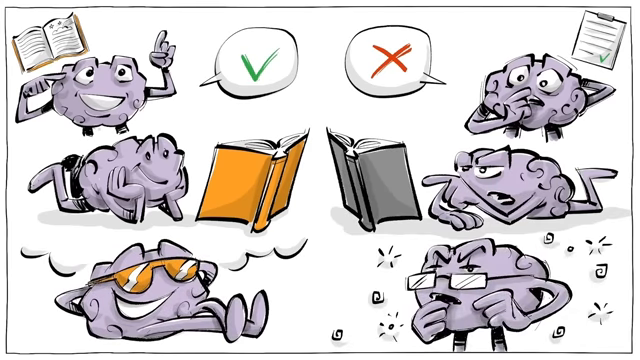
These are tendencies, not rigid rules about every book. The useful distinction is between the emotional force of a particular experience and the organizing power of an explicit explanation.
Better Learning Combines Both
Good educators do not have to choose between storytelling and facts. They can combine them.
In the tragedy example, the definition gives us a framework. Oedipus gives us something concrete to understand through that framework. Returning to the definition after the story helps connect the emotional experience to the larger idea.
The same balance matters when considering war. One person’s death can be understood as an intimate tragedy. A million deaths can become an abstract statistic. The personal story helps us feel the human loss; the numbers help us grasp its scale. Neither perspective is sufficient on its own.
Stories help us care and remember. Facts help us organize, compare, and generalize. A powerful education makes room for both, without mistaking a memorable example for the whole truth.
Parents and educators can find additional resources and suggested classroom activities on our Facts vs Fiction lesson page.
|