How much freedom should a child have? How firm should parents be? And when does helping become too much help?
Four widely researched parenting styles offer a way to think about these questions: authoritarian, permissive, authoritative, and neglectful. A fifth pattern, over-involved parenting, describes parents who take such an active role that their children have little room to manage challenges alone.
These styles differ not simply in how much parents love their children, but in how they express that love, set limits, and respond to a child’s needs. To understand their possible effects, imagine the lives of four children, then consider what happens when parental involvement goes too far.
Key Takeaways
- Parenting styles differ in the balance between parental expectations and responsiveness to children’s needs.
- Authoritative parenting combines clear limits with warmth, listening, and support for independence.
- Removing every obstacle can deprive children of opportunities to develop perseverance and solve problems independently.
- Research limitations mean parenting styles should guide reflection rather than predict a child’s future.
Understanding the Parenting Styles
The four main parenting styles can be organized along two dimensions:
- Demandingness: How much control, structure, and expectation parents bring to their child’s life.
- Responsiveness: How warmly and attentively parents respond to their child’s feelings and needs.
Combining these dimensions gives us four different patterns:
- Authoritarian: High demands, with little room for the child’s perspective.
- Permissive: Plenty of warmth, but few rules or limits.
- Authoritative: Clear expectations combined with warmth and responsiveness.
- Neglectful: Little guidance and little emotional involvement.
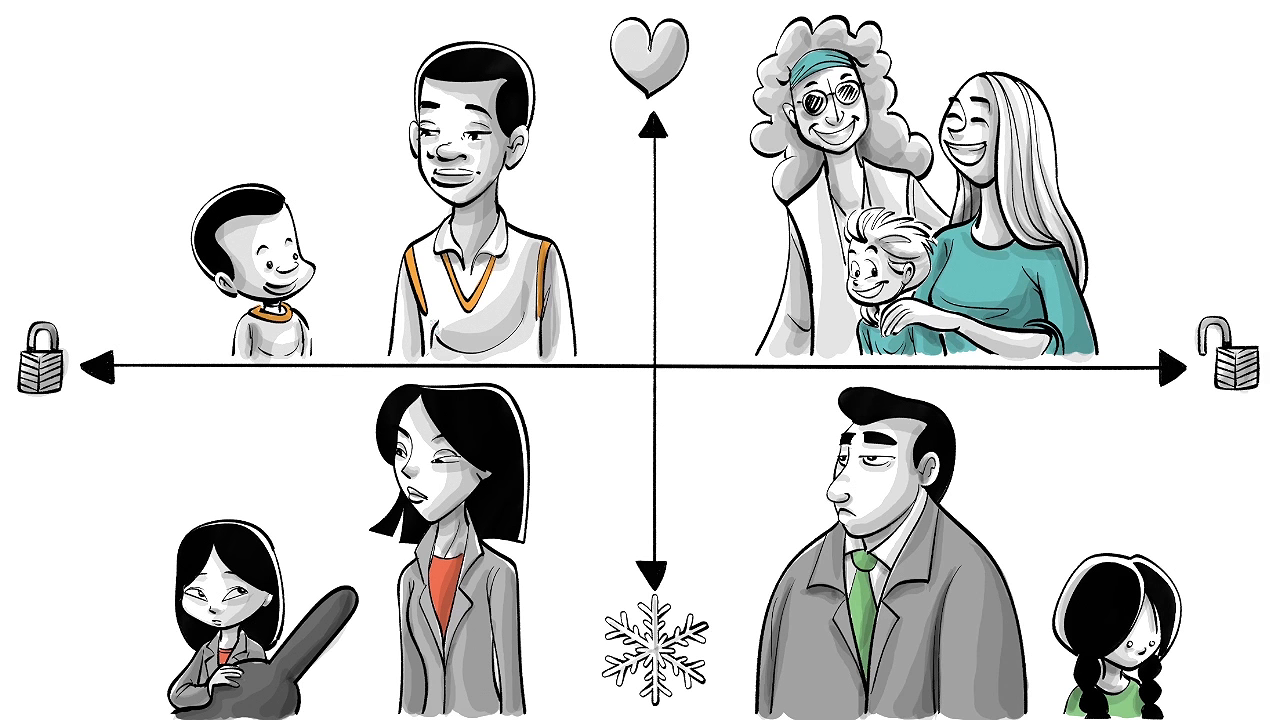
These are useful models, not predictions of a child’s future. The following stories illustrate how each pattern might shape a child’s understanding of emotions, independence, and relationships.
1. Authoritarian Parenting: Obedience Comes First
Sara’s parents love their daughter. They also believe strict rules will help her behave well and fit into society. What matters most is that she obeys.
If Sara cries, she is told to stop. If she talks back, she is sent to the corner for a timeout. If she forgets her chores, she loses permission to play with her toys.
Over time, Sara learns that the safest way through the day is to suppress her emotions and carry out her duties. To keep her parents happy and feel worthy of their affection, she becomes obedient.
But obedience is not the same as independence. Sara has had little opportunity to make decisions or explore her own interests. As an adult, she may struggle to know what she actually wants.
Her life might look successful to her parents and to society, yet leave her unhappy inside. The risk is that learning to meet other people’s expectations comes at the expense of understanding herself.
2. Permissive Parenting: Love Without Limits
Peter’s parents take a very different approach. They love their little boy so much that they want to fulfill every wish. To them, giving him freedom means rarely, if ever, saying no.
- If Peter does not want to walk, they carry him.
- If he wants ice cream, he gets ice cream.
- If he wants to play games all night, no one stops him.
Peter enjoys considerable control over family life. But without boundaries, he has few opportunities to practice accepting disappointment, coping with conflict, or managing strong emotions.
Getting what he wants feels pleasant in the moment. It does not prepare him for losing a game or dealing with people who have wishes of their own.
As he grows older, Peter may struggle to recognize limits and behave considerately toward others. Warmth provides affection, but warmth alone does not teach self-control.
3. Authoritative Parenting: Freedom Within Limits
Arthur’s parents respect his needs and encourage his independence. They also believe that children need clear boundaries.
Arthur can play freely, but afterward he helps tidy up. In his family, ice cream is reserved for Sundays, and screen time is limited to 30 minutes a day. These particular rules illustrate the approach rather than prescribe a schedule for every household.
Conflict still happens. The difference is that Arthur’s parents listen to what he has to say before making the rules clear. Listening does not mean giving in. In this example, they hold their boundaries without relying on rewards or punishments.
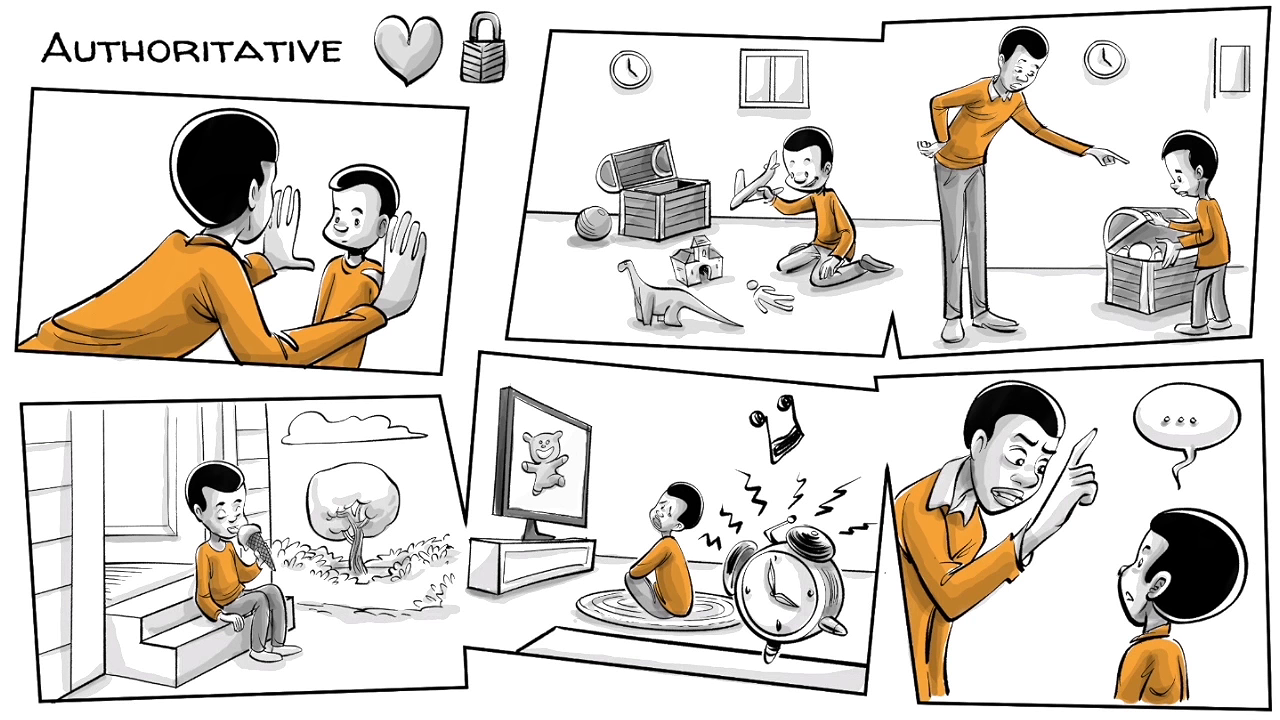
When something is difficult, Arthur receives support rather than having every difficulty removed. He gets the chance to develop perseverance while continuing to pursue his interests.
At school, he can express his opinions appropriately. During breaks, he feels free to show his emotions and play. As an adult, he wants to discuss and understand rules rather than simply accept them without question.
Authoritative parenting combines two things that can seem opposed: firm limits and respect for the child’s point of view. The limits provide structure. The responsiveness gives the child a voice.
4. Neglectful Parenting: Freedom Without Support
Nora has plenty of freedom, but not because her parents are carefully encouraging independence. They are largely absent from her life.
She can do what she wants and has a rich imagination. Yet she receives little feedback, affection, or attention. The freedom that Peter experiences alongside warmth is, for Nora, accompanied by loneliness.
Eventually, she begins to feel that nothing she does matters because no one seems to care. Without dependable attention, she may struggle to trust herself or other people.
In this imagined life, Nora develops an insecure attachment pattern and a negative image of herself. Building healthy relationships becomes difficult. To protect herself from feeling unworthy of love, she tries to stop feeling much at all.
A lack of restrictions is not the same as supported independence. Children also need connection, attention, and a sense that their experiences matter.
5. Over-Involved Parenting: When Help Takes Over
At the opposite extreme from neglect are parents who become involved in nearly every aspect of their child’s life. This pattern is often described as a fifth parenting style.
Two familiar names capture different versions of it:
- Snowplow parents remove obstacles from their child’s path.
- Helicopter parents hover nearby and micromanage what their child does.

The problem is not that these parents are present. It is that they leave too little room for their children to act alone.
If adults continually remove difficulties or take charge, children lose opportunities to practice overcoming challenges. Research discussed in this area suggests that these children may be less willing to tackle difficult problems, show less perseverance, or procrastinate in protest when a task demands considerable effort.
Helping can solve the immediate problem while leaving the child less prepared for the next one.
What Parenting Research Can and Cannot Tell Us
These stories make the differences easy to understand, but real lives are more complicated. Much parenting research relies on self-reports, and much of it has been conducted in the United States and Europe.
That leaves important questions. How closely do people’s accounts match their everyday behavior? How well would the observed patterns hold up under controlled observation? And how consistently do findings apply in other cultural settings?
Parenting styles are a framework for reflection, not a guarantee of particular outcomes. For further context, explore this evidence-based, cross-cultural guide and this review of parenting dimensions and styles.
Finding the Balance: Structure, Warmth, and Independence
The parenting-style framework has its roots in psychologist Diana Baumrind’s work. A central principle is to balance expectations with responsiveness: provide guidance while remaining attentive to the child.
Maria Montessori offered a complementary idea: resist taking over a task when a child feels capable of succeeding independently.
Together, these ideas suggest a useful balance:
- Set limits without treating obedience as the only goal.
- Listen and respond without granting every wish.
- Offer support without removing every obstacle.
- Allow independence without withdrawing affection or attention.
Must parents commit to one label, or should they decide what a situation calls for? The more useful question may be whether their response gives the child both dependable care and room to grow. Avoiding neglect and abuse is essential. Beyond that, good parenting involves finding a balance between guiding children and allowing them to discover what they can do themselves.
For educational use, our lesson library includes download options, including versions without background music, along with licensing information.
|


