What if a small share of what you do produces most of what you achieve? The Pareto Principle, also known as the 80/20 rule, offers a simple way to think about this imbalance: often, around 20% of the causes produce roughly 80% of the outcomes. The remaining causes account for the rest.
Applied to personal success, the idea becomes especially tempting: 20% of your effort might produce 80% of your results. Identify that productive portion, and you have a useful clue about where to focus next.
But the rule is a starting point for understanding a situation, not a substitute for understanding it.
From Pea Pods to Land Ownership
The principle takes its name from Italian economist Vilfredo Pareto. Its origin story connects two observations: a small proportion of the pea pods in his garden produced most of the peas, and about 80% of the land in Italy belonged to just 20% of the population.
In both cases, the important feature was an uneven distribution. Each pea pod did not contribute equally to the harvest, just as each person did not own an equal share of the land.
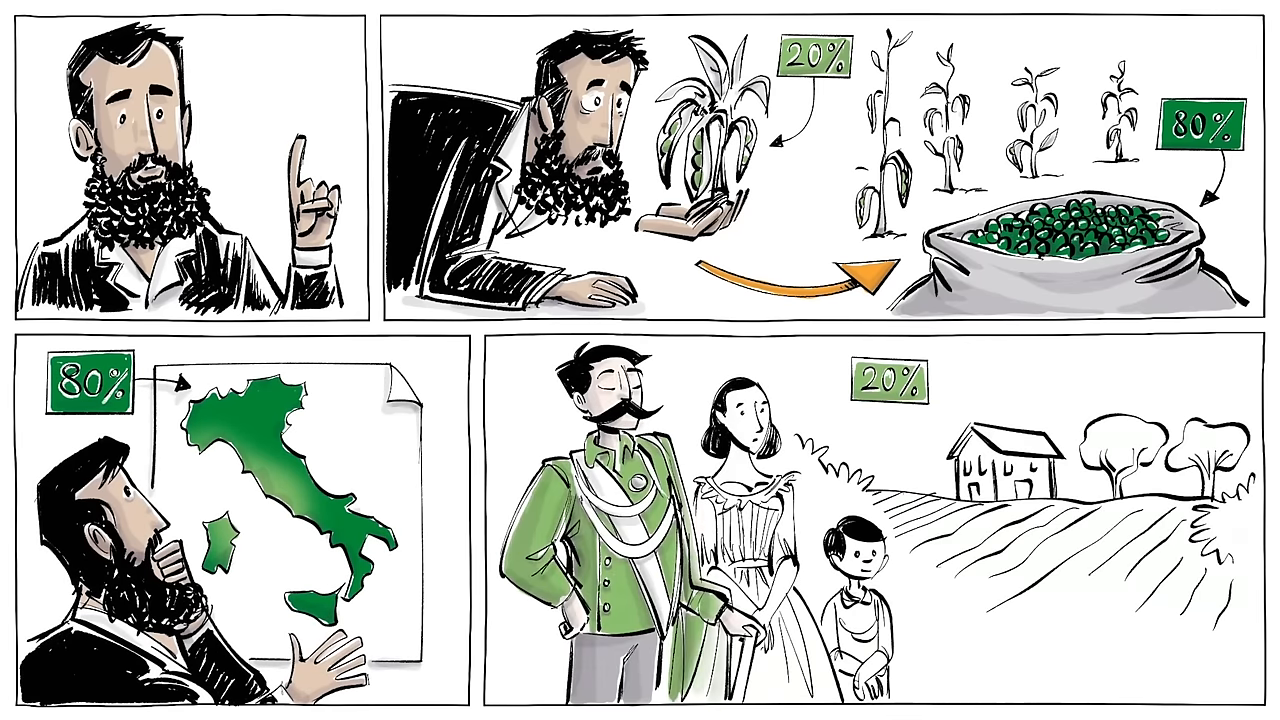
Over time, the Pareto Principle became a useful rule of thumb for making sense of complex distributions. It encourages us to look beyond the total number of inputs and ask which ones contribute most to the outcome.
The useful insight is not that everything divides neatly into 80 and 20. It is that causes and results often have an unequal relationship. Recognizing that imbalance can help us focus on the essentials and decide what deserves attention first.
How the 80/20 Rule Helps Set Priorities
The principle becomes practical when it changes a decision. Three examples show how the same pattern can guide very different kinds of work.
Business: Identify the Customers Who Contribute Most
A business owner may discover that around 80% of the company’s income comes from only 20% of its customers. That finding makes it easier to identify which customer relationships deserve special attention.
The lesson is not simply to count customers. It is to understand how much each contributes to the result the business is trying to achieve.

Construction: Address the Hazards Behind Most Injuries
If a construction team finds that 20% of its hazards cause 80% of its injuries, it has identified an important place to take precautions. Tackling those hazards first can address a large share of the problem.
Here, the principle helps turn a broad concern, workplace safety, into a more focused question: which hazards are responsible for most of the harm?
Software: Fix the Bugs Behind Most Errors
Software engineers might find that the most frequently reported 20% of bugs account for 80% of errors. Prioritizing those bugs could remove much of the trouble before every defect has been fixed.
Of course, the other bugs do not politely disappear. They may continue bugging people. Choosing what to fix first is not the same as proving that everything else can be ignored.
Pareto’s Warning: Reasoning or Rationalizing?
An appealing rule can make a decision feel more logical than it really is. Pareto’s broader warning about human reasoning is relevant here: people often act on their feelings and self-interest, then find a theory that makes those actions appear reasonable.
If someone disproves that theory, they may simply replace it with another that serves the same purpose. The explanation changes; the preferred conclusion stays put.
That is a useful caution when applying the 80/20 rule. Are we finding a meaningful pattern in the evidence, or choosing a neat explanation for something we already wanted to do? For a deeper examination of its limitations, this critical discussion of the Pareto Principle offers further reading.
A Useful Lens, Not the Whole Picture
The best use of the Pareto Principle is to sharpen a question, not end the investigation. Where do a few causes account for most of the results? Which deserve priority? And where is a more thorough analysis needed to understand what is happening?
Use the 80/20 rule to notice uneven contributions and focus your attention. Then check whether the situation actually supports the pattern. A simple rule is most helpful when it makes us think more clearly, not when it gives us permission to stop thinking.
|