Why does a young child think a taller glass holds more juice, even when the juice was simply poured from a shorter one? And how do we move from exploring everything with our hands and mouths to thinking about love, morality, and the future?
Piaget’s theory of cognitive development describes this journey through four stages of thinking. Each stage brings a different way of understanding the world, not simply more knowledge.
In Piaget’s model, these stages follow a sequence, although the age at which we move through them can vary:
- Sensorimotor stage: birth to about age 2.
- Preoperational stage: about ages 2 to 7.
- Concrete operational stage: about ages 7 to 11.
- Formal operational stage: about age 12 onward.
The progression takes us from learning through physical experience to reasoning about ideas that we cannot see or touch.
Key Takeaways
- Piaget described four stages that change how we think, not simply how much we know.
- Early learning develops through sensory exploration, movement, symbolic language, and pretend play.
- Concrete operations bring logical thinking, conservation, reversibility, and greater understanding of other perspectives.
- Formal operations enable abstract reasoning, hypothetical thinking, systematic planning, and reflection on thought itself.
1. The Sensorimotor Stage: Birth to Age 2
Our first way of learning is through our senses and movements. We look, listen, smell, taste, and touch. The world is something to explore with our whole body.
At first, our actions are simple reflexes. These gradually develop into habits. From around four months, we become increasingly aware of things beyond our own body. As we grow, we begin to act intentionally rather than merely respond.
Discovering Object Permanence
A key milestone is object permanence: understanding that something continues to exist even when we cannot see it.
Imagine a parent showing us a teddy bear and then hiding it. Before we develop this understanding, the bear may seem to have disappeared altogether. Later, we realize that it is still there, just out of sight.
This marks an important change. Our understanding of the world no longer depends entirely on what is immediately in front of us.
Moving More Means Exploring More
As our curiosity grows, we want to smell flowers, taste food, hear new sounds, and interact with people. Physical development gives us more ways to investigate. We learn to sit, crawl, stand, walk, and eventually run.
Greater mobility opens up more experiences, which in turn support cognitive development. Movement is not separate from learning. At this stage, it is one of our main ways of learning.
Our perspective, however, remains egocentric. Here, egocentric does not mean deliberately selfish. It means that we experience the world from our own point of view and cannot yet readily consider another person’s perspective.
2. The Preoperational Stage: Ages 2 to 7
During the preoperational stage, our thinking becomes full of symbols, imagination, and intuitive ideas. We develop language and understand that words, images, and gestures can stand for something else.
A word can represent a person who is not in the room. A drawing can represent our family. A gesture can communicate an idea without saying a word.
Symbols and Pretend Play
When we draw our family, accurate proportions may not matter very much. What matters is whom each figure represents. The drawing expresses meaning rather than a precise record of size and scale.
Pretend play becomes another way to explore. We can take on a role, imagine a situation, and experience something new through play. Our fantasy life is rich, and we may even believe that objects are alive.
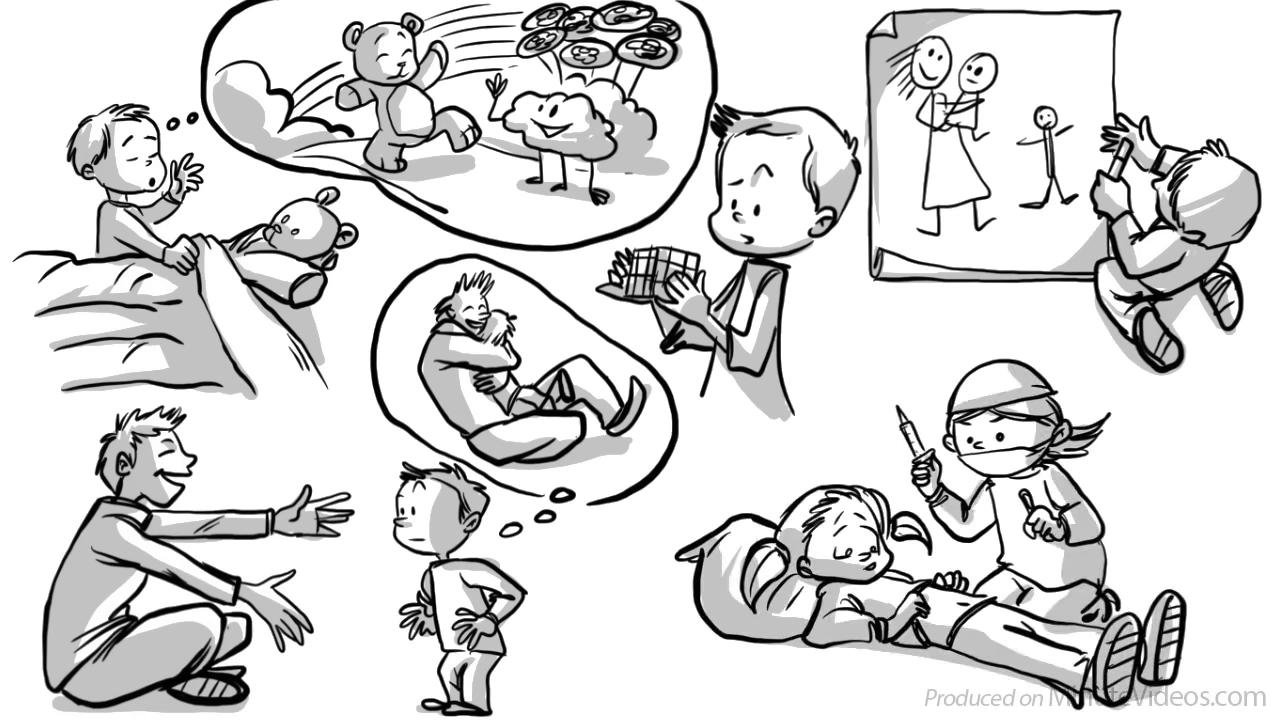
Piaget called this stage preoperational because we cannot yet consistently apply the logical mental operations that emerge in the next stage. Being able to represent something is not the same as being able to reason logically about it.
The Intuitive Age
At around age four, many of us become enthusiastic questioners. We want to know everything. This growing curiosity marks the beginnings of reasoning.
Piaget described this period as intuitive because we may feel that we know a great deal without understanding how we arrived at that knowledge. Our answers often rest on what seems immediately true rather than on a clear logical process.
Our thinking also remains largely egocentric. We tend to assume that other people see and understand the world as we do. Recognizing that someone else can have a genuinely different perspective is still a challenge.
3. The Concrete Operational Stage: Ages 7 to 11
Now our thinking becomes more logical, especially when we are dealing with concrete objects and situations. We can sort objects, arrange them in an order, classify information, and mentally work through changes.
We also develop inductive reasoning: moving from particular observations toward a broader conclusion. Observing someone eating a cookie, for example, can become the starting point for drawing an inference and forming a generalization. Our thinking is beginning to connect individual experiences into larger patterns.
Understanding Conservation
One important achievement is conservation: recognizing that a quantity can remain the same even when its appearance changes.
Imagine pouring orange juice from a short glass into a taller, narrower glass. We now understand that the amount of juice has not changed. The liquid looks different, but nothing has been added or taken away.
A younger sibling might choose the taller glass, convinced that it contains more. During the concrete operational stage, we can look beyond height alone and reason about what actually happened.
Understanding Reversibility
We also begin to understand that an action can be reversed by doing its opposite. This is called reversibility.
In arithmetic, if 3 + 5 = 8, then 8 − 3 = 5. We can mentally follow the operation in one direction and then work backward.
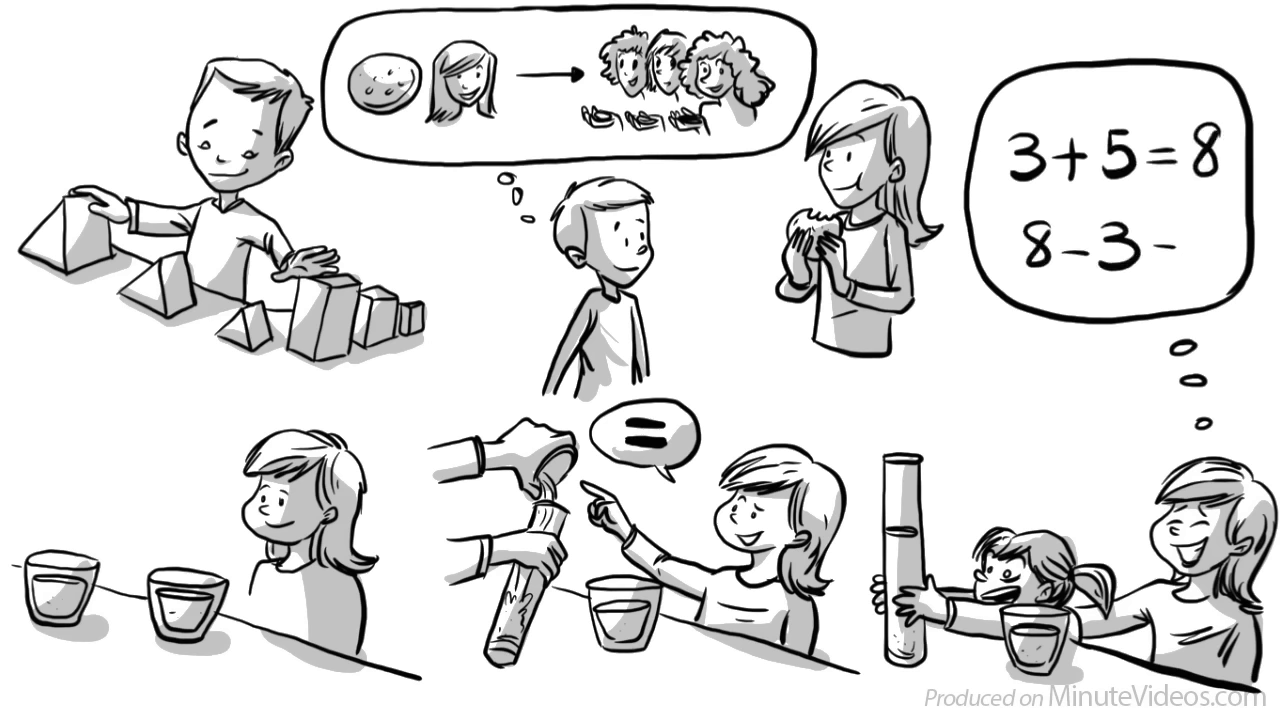
These abilities help us organize our thoughts into more coherent mental structures. We use them in conversations, activities, writing, and schoolwork.
Recognizing Other Perspectives
Our understanding of ourselves and others changes, too. We increasingly recognize that our thoughts and feelings are our own, not necessarily those of everyone around us.
We become better able to put ourselves in another person’s shoes. Someone else can experience the same situation differently, and their perspective need not match ours.
4. The Formal Operational Stage: Age 12 and Beyond
In Piaget’s model, adolescence brings the capacity for abstract and hypothetical thinking. We can reason about possibilities, not just concrete situations we have directly experienced.
Ideas such as success and failure, love and hate become subjects for deeper reflection. We develop a more complex understanding of our identity and morality. Thinking about why people behave as they do can also support greater compassion.
Reasoning About Possibilities
Formal operational thinking includes deductive reasoning: using premises or general principles to reach a logical conclusion. Rather than only building generalizations from observations, we can consider what must follow if certain statements are true.
These developing abilities allow us to:
- Plan systematically and decide what to prioritize.
- Consider hypothetical events, including situations that do not reflect present reality.
- Explore philosophical questions about abstract ideas.
- Think about thinking itself and reflect on our own mental processes.
A New Form of Egocentrism
A stronger sense of identity can also bring renewed self-consciousness. Some adolescents imagine an audience constantly noticing and judging them.
This is different from a young child’s difficulty understanding another perspective. Here, the developing sense of self can make us feel as though we are always the center of other people’s attention.
Piaget regarded formal operations as the final stage of cognitive development. But a final stage does not mean a final lesson. He believed that learning continues throughout life.
How Piaget Came to Study Children’s Thinking
Jean Piaget first developed an interest in animals. In 1907, at just 11 years old, he published his first scientific paper, about an albino sparrow.
In 1920, he began working with standardized intelligence tests. Something about the mistakes children made caught his attention: younger children consistently made certain kinds of errors that older children did not.
He concluded that younger children were not simply missing information. They were thinking differently. That observation became the starting point for a lifetime spent studying children’s intellectual development.
The central idea of his theory is that growing up changes not only what we know, but how we think. From searching for a hidden teddy bear to considering an imagined future, each stage opens a new way of making sense of the world.


