The Pygmalion effect describes a phenomenon in which higher expectations can lead to higher performance. What we believe about another person’s abilities can influence how we treat them. That treatment, in turn, can affect what they believe about themselves and how they act.
The result is a circle. Our expectations help shape someone’s behavior, and that behavior seems to confirm what we believed all along. We may think we simply recognized their potential, without noticing how much we helped it develop.
How the Pygmalion Effect Works
The process is easiest to understand as a repeating cycle:
- Our beliefs about someone influence our actions toward them. We give them more encouragement, attention, or opportunities, or we offer less.
- Our actions influence their beliefs about themselves. They begin to feel capable and appreciated, or overlooked and unlikely to succeed.
- Their beliefs influence their actions. Their confidence, effort, and willingness to participate change.
- Their actions reinforce our original beliefs. We interpret their behavior as evidence that our first judgment was right.
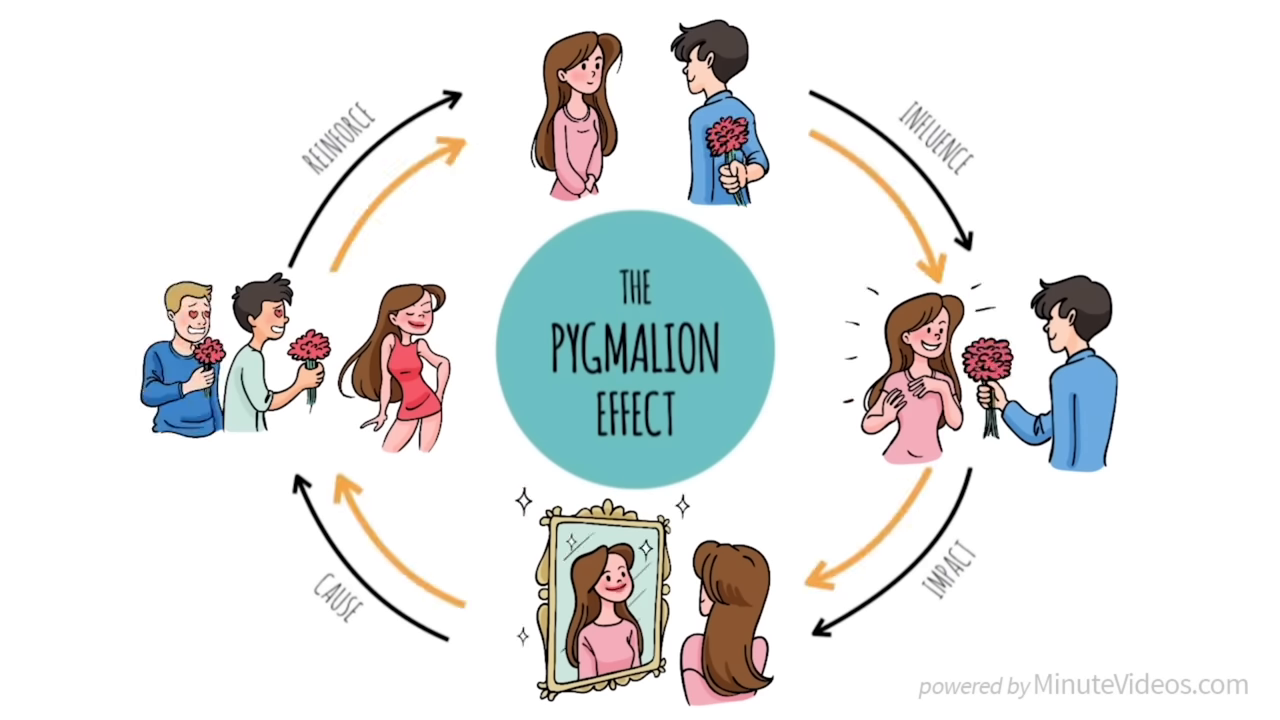
This is a form of self-fulfilling prophecy. The expectation does not stay inside our heads. It changes our behavior in ways that can make the expected outcome more likely.
A Basketball Coach, Two Players, and Two Different Expectations
Imagine you coach a basketball team. On the first day, you meet two new players, Chris and Joe.
Chris reminds you of a famous basketball player. Joe reminds you of an annoying boy you knew in high school. Neither association tells you much about their actual basketball ability. Yet, without realizing it, you begin to expect different things from them.
Your beliefs change how you coach
When Chris steps onto the court, you are pleased to see him. You push him to improve, encourage him to practice harder, and ask him to stay for an extra hour. When he makes a mistake, you explain what went wrong and how to do better.
When Joe arrives, you barely notice. You are happy when he scores, but you give him little feedback and invest no extra time in his training. When he makes a mistake, you feel annoyed.
Both players make mistakes, but only one consistently receives help turning those mistakes into progress. Your expectations have already begun to create different learning conditions.
Your coaching changes their self-belief
Chris feels appreciated. He values your support and begins to believe in his own success.
Joe senses your lack of patience and interest. He feels less appreciated and finds it harder to believe he will succeed.

Their self-belief changes their behavior
Chris finds more and more joy in basketball. He never misses a training session and gives his full effort during games.
Joe enjoys the sport less than before. He puts less effort into games and occasionally skips practice.
Their behavior seems to prove you right
You notice that Chris works hard, enjoys playing, and improves quickly. Joe seems unmotivated, develops more slowly, and shows up less often.
Of course, you think. You knew it from the beginning. What excellent instincts!
But your original judgment was not simply a prediction. Through your attention, feedback, and patience, you helped create the difference you now see.
Robert Rosenthal’s Expectation Experiments
The Pygmalion effect is closely associated with psychologist Robert Rosenthal and his research on how expectations influence outcomes.
The rat maze experiment
In an early experiment, participants were asked to guide rats through a maze. One group was told that its rats were exceptionally intelligent and specially trained. The other group was told that its rats were unintelligent.
In reality, there was no basis for the supposed difference between the groups. The labels had been supplied to shape the handlers’ expectations.
Nevertheless, the rats described as intelligent performed better than those described as unintelligent. The experiment suggested that the handlers’ expectations could influence performance even in animals. The important difference was not what the rats had been called, but how those labels could affect the people working with them.
The Pygmalion in school study
Rosenthal later worked with Lenore Jacobson on a study in an elementary school. At the beginning of the school year, teachers were told that certain pupils had unusual talent and potential.
Those pupils had actually been selected at random. The information about their exceptional potential was invented, rather than based on evidence that they were more talented than their classmates.
All the children had taken an IQ test beforehand. By the end of the year, the researchers reported that the pupils identified as especially promising showed significantly greater gains in IQ test performance than the rest of the class.
Rosenthal’s central conclusion was that expecting a particular behavior can lead us to act in ways that make that behavior more likely. For further context, the original findings have also prompted debate about replication and interpretation.
What Are Your Expectations Helping to Create?
The lesson is not simply to think positively about someone. In the basketball example, belief matters because it changes concrete actions: the time offered, the feedback given, the patience shown, and the encouragement to keep practicing.
A useful question for any teacher or coach is therefore: Am I responding only to this person’s performance, or am I also helping to shape it?
The reverse question matters, too. When someone expects little of us, how much of that expectation do we begin to accept as our own?
The Pygmalion effect invites us to look more carefully at both sides of the circle. Before deciding that someone has proved our first impression right, it is worth asking what part our own behavior played.
|