Your brain has a remarkable capacity for learning. One estimate of its memory capacity puts it at about 2.5 petabytes, roughly equivalent to three million hours of video. But making good use of that potential is not simply a matter of spending more hours at a desk.
How you practice, when you rest, and what you do to recall information all matter. These 13 study tips turn ideas from neuroscience and learning research into practical habits you can try.
Key Takeaways
- Combine short, regular study sessions with sleep and reviews spaced across days, weeks, and months.
- Protect your attention by removing distractions and alternating focused work with short breaks.
- Practice recalling information through recitation, quick quizzes, and summaries rather than relying on rereading.
- Make room for enjoyable practice, exercise, conversation, and rest instead of forcing constant effort.
Table of Contents
- 1. Study in Short, Regular Sessions
- 2. Find a Way of Studying That Suits You
- 3. Get a Good Night’s Sleep
- 4. Protect Your Focus
- 5. Use the Pomodoro Technique
- 6. Do the Hard Stuff First
- 7. Exercise, Meditate, and Converse
- 8. Change Your Study Location
- 9. Take Fun Seriously
- 10. Space Your Reviews Over Time
- 11. Spend More Time Reciting Than Reading
- 12. Finish With an Immediate Self-Test
- 13. Don’t Force It
1. Study in Short, Regular Sessions
Study a little, but study often. Rather than squeezing all your practice into one long sitting, spread it across several days.
Learning involves changes in synapses, the connections between neurons that help us remember and understand things. Sleep plays an important role in strengthening and organizing what we learn. Regular practice with nights of sleep in between gives your brain opportunities to consolidate new information.
Try practicing something for just 15 minutes every day. Keep it up for a few weeks and notice how much progress those small sessions can produce.
2. Find a Way of Studying That Suits You
Imagine two students in a history lesson. Tom sketches pictures as he listens. Jane works her way through a generous supply of nuts. Their routines look different, but both are trying to stay engaged.
Some people prefer a visual explanation to a book. Others enjoy studying with friends, while some want silence and shelves full of reading material.
Experiment with the format and setting that help you engage with the subject. Drawing, reading, discussing, and studying alone are options to explore, not labels you need to fit into. The useful question is whether your approach helps you understand and remember.
3. Get a Good Night’s Sleep
Sleep is not time stolen from learning. It is part of the process of storing new information.
A study highlighted in the learning research found that students who slept between studying and testing remembered their materials about 35% better than a comparison group who studied in the morning and took a test that evening. That figure describes a particular study, not a guaranteed improvement for every learner, but the practical lesson is clear: give your brain time to sleep after learning.
It is tempting to judge a study day by how long you stayed awake. A better goal is to combine useful practice with the rest that helps it stick. For more context, see this explanation of sleep and memory consolidation.
4. Protect Your Focus
Procrastination often means trading something difficult for something easy. A challenging mathematics problem is suddenly less appealing than browsing the web.
Instead of relying entirely on willpower, make distraction less convenient:
- Shut down your phone during a study session.
- Step away from casual web browsing.
- Choose a quiet place, such as a library.
The aim is simple: give the task in front of you a fair chance to hold your attention.
5. Use the Pomodoro Technique
A study session feels more manageable when it has a clear beginning, an end, and a break to look forward to. The Pomodoro Technique provides that structure.
- Set a timer for 25 minutes.
- Focus entirely on your studies until it rings.
- Relax for 5 minutes.
- If you want to continue, set the timer again.
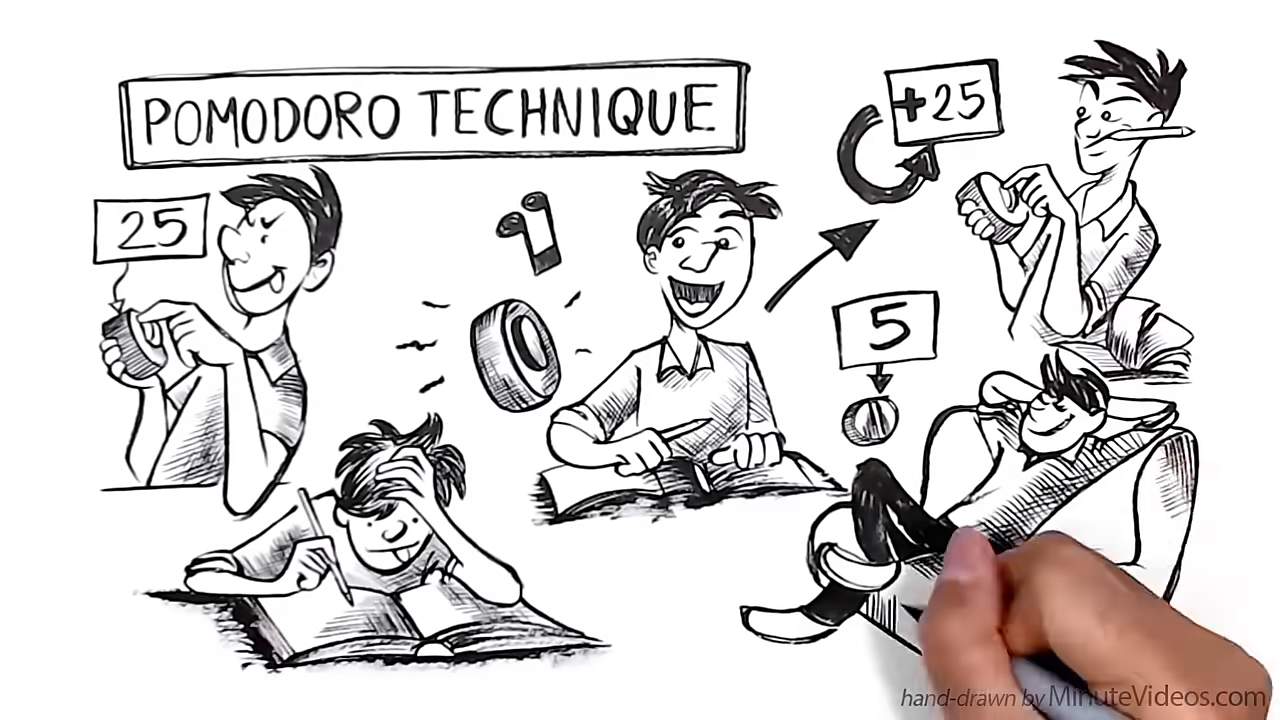
Those small breaks are not a failure of concentration. They are built into the routine to make continued effort feel more achievable.
6. Do the Hard Stuff First
Put the difficult work near the beginning of your day, particularly if mornings are when you feel most ready to tackle a challenge.
The idea is to give demanding tasks your freshest effort rather than leaving them until you have already worked through everything else. Once the hard part is finished, you may feel better about the rest of the day and more motivated to keep going.
Start with the task you are most tempted to postpone. Completing it can make the remaining work feel much less intimidating.
7. Exercise, Meditate, and Converse
Not every activity that supports learning happens over a textbook. Physical exercise, regular meditation, and good conversations deserve space in your routine too.
These activities are connected with brain health and the brain’s ability to change. Research on brain growth and new neurons provides part of the background, though it is too simple to say that every conversation or meditation session directly produces new brain cells.
The practical message is more useful than that shortcut: make room for movement, quiet reflection, and meaningful interaction. A learning routine does not have to mean sitting alone with your notes all day.
8. Change Your Study Location
A different setting can give a subject a richer set of associations. The room around you provides visual cues, and changing those surroundings can help you encounter the same material in a new context.
In one experiment, two groups of students studied random words. One group stayed in the same room. The other studied in two different rooms, one small and windowless, the other large and bright.
The group that changed rooms recalled about 40% more words later. The result is an example of how surroundings can influence memory, not a promise that moving rooms will always deliver the same benefit.
Try changing your study location occasionally while keeping distractions under control. A useful change of scenery should support your attention, not compete with it.
9. Take Fun Seriously
Whatever you are practicing, look for a way to enjoy it.
Positive emotions can support learning. Fun is not necessarily the opposite of serious effort; it can help make that effort something you want to return to.
You do not need to turn every subject into entertainment. Just pay attention to the parts that make you curious, interested, or pleased with your progress. A good learning routine can be challenging and enjoyable at the same time.
10. Space Your Reviews Over Time
Short daily practice builds a habit. Spaced review helps you return to particular information after time has passed.
For facts or vocabulary, try this starting schedule:
- First review: one or two days after the initial study session.
- Second review: about one week after the initial session.
- Third review: about one month after the initial session.
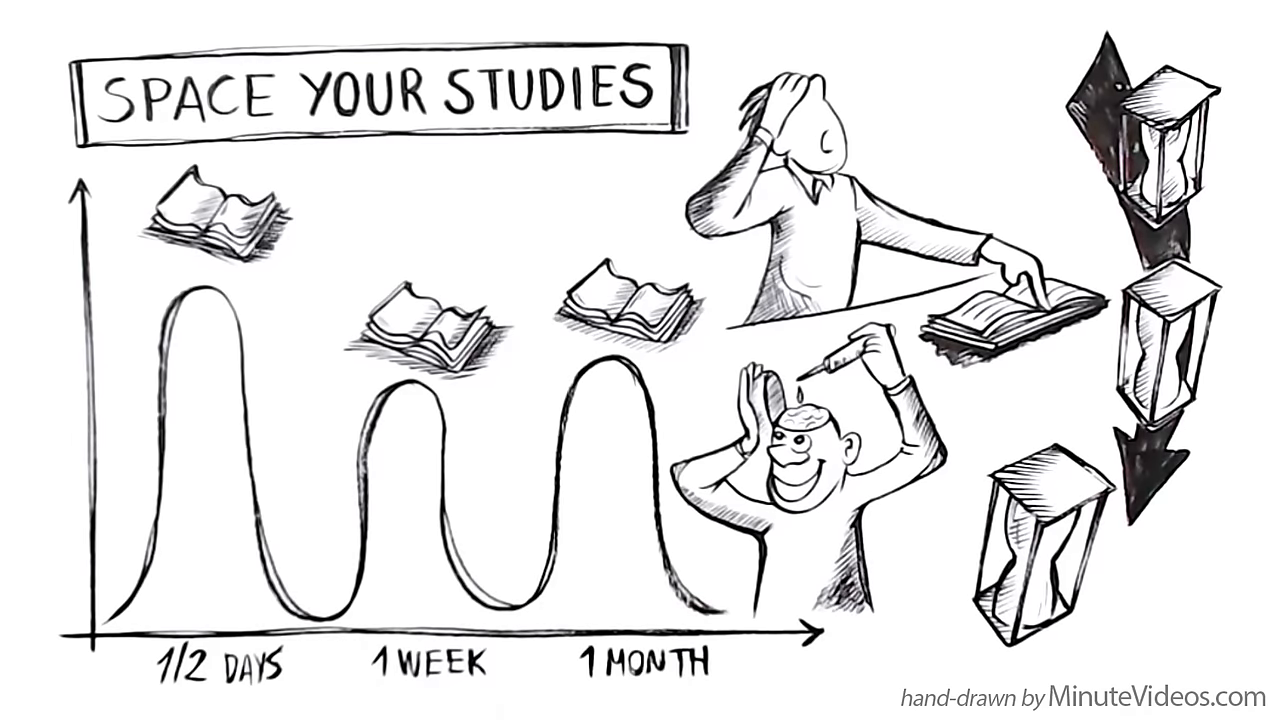
The point is to revisit material rather than assume one successful study session will last forever. Spaced repetition makes those returns a planned part of learning.
11. Spend More Time Reciting Than Reading
If your goal is to recite a poem or deliver a speech, reading the text is only part of the work. You also need to practice producing it.
A useful rule of thumb is to devote roughly 30% of your time to reading and 70% to reciting. For a one-hour session, an easy approximation is 20 minutes studying the text and 40 minutes practicing it aloud.
Treat the ratio as a reminder to prioritize practice, not as a precise formula for every task. You are preparing to say the words, so give yourself plenty of time doing exactly that.
And keep a glass of water nearby. If you lose your place, a small sip gives you a perfectly respectable pause.
12. Finish With an Immediate Self-Test
Before you close your study session, give yourself a quick quiz or summarize what you have just learned without looking at the material.
Retrieving information is more demanding than rereading it. That extra effort is part of what makes self-testing valuable: you are practicing bringing the knowledge back, rather than simply recognizing it on a page.
Immediate recall has been associated with retention improvements of up to about 30% in the research highlighted here, although the size of the benefit depends on the task and conditions. Research on test-enhanced learning explores why retrieval can support longer-term memory.
A self-test does not need to be elaborate. A short summary or a few questions can turn the end of a study session into another opportunity to learn.
13. Don’t Force It
Motivation is a little like hunger. You cannot always summon it simply by deciding that it ought to be there.
If you are not mentally hungry right now, do not turn that moment into a battle with yourself. Take a break and do something else.
Better learning is not about forcing maximum effort into every minute. It is about combining focused practice, active recall, spaced review, rest, and enough enjoyment to keep returning. Give your brain useful work, then give it room to recover.


