Play gives us a way to explore, experiment, and discover what happens when we try something new. Video games bring that process into interactive worlds, where a failed attempt often leads straight to another opportunity.
Teachers already use games in class and for homework. But what makes a game useful for learning? It helps to look at three dimensions of game design, four kinds of potential benefits, and five games that turn play into meaningful learning experiences. One even puts business students at Harvard in charge of a root beer supply chain.
Key Takeaways
- Game design shapes learning through complexity, participation, and competitive or cooperative interaction.
- Specific games can support cognitive skills, motivation, emotional regulation, and social development.
- Educational value depends on what players practice and whether those skills transfer beyond the game.
Three Dimensions of Video Game Design
Video games differ in more than their stories and graphics. Three dimensions help explain what players are asked to do:
- Complexity: Is the game relatively simple, or does it require players to manage many interacting challenges?
- Participation: Does a person play alone or with other people?
- Interaction: Do players compete, cooperate, or do both?
We can map games along two broad axes: simple to complex, and non-social to social. This creates four useful categories:
- Simple, non-social games: Puzzles and platform games such as Super Mario.
- Complex, non-social games: Single-player experiences such as Far Cry or simulations such as SimCity.
- Simple, social games: Multiplayer experiences such as Guitar Hero or Need for Speed.
- Complex, social games: Multiplayer experiences such as Halo, Minecraft, or Among Us.
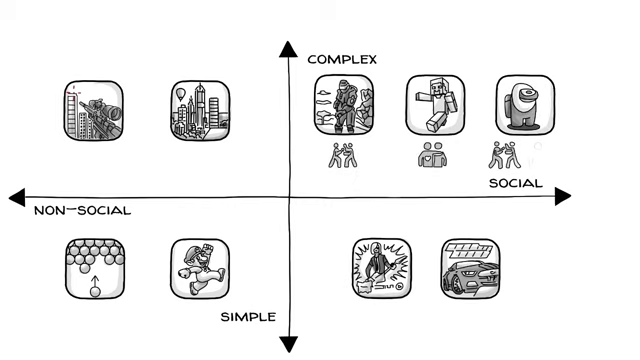
These categories describe ways of playing rather than rigid labels for every title. A game can offer different modes, and competition and cooperation can exist within the same experience.
Complex multiplayer games can be especially rich environments for learning. They combine demanding tasks with the need to respond to other people. Players may have to solve a problem while also deciding whom to trust, how to communicate, and when to take the lead.
Four Things Video Games Can Help Us Learn
The educational potential of games extends beyond learning facts. Research points to possible benefits for cognition, motivation, emotions, and social skills. These are potential outcomes of particular experiences, not a promise that every game teaches every skill. A research review on the benefits of playing video games explores these four areas.
1. Cognitive Skills
Some games give players repeated practice in specific kinds of thinking. One meta-analysis found that video game training can improve mental rotation, the ability to imagine an object turning in space. It also found evidence that this learning can transfer beyond the game.
Other games can support logic and mathematical thinking. The important connection is between the task a game requires and the skill a player practices.
Shooter games, for example, often demand close attention to relationships among objects in space. Research discussed in this area suggests that these games can train particular spatial skills more effectively than conventional high school instruction. That is a claim about a specific ability, not about replacing a school curriculum with a shooter.
2. Motivation and a Growth Mindset
A well-designed game keeps the next challenge within reach. Feedback helps players understand how they are doing, while adjustments in difficulty can keep the experience challenging without making progress feel impossible.
This resembles Lev Vygotsky’s zone of proximal development: the space between what a learner can do independently and what becomes possible with support. In games, prompts, feedback, and structured challenges can provide some of that support.
Games also make trying again part of the process. Players attempt a task, fail, change their approach, and improve. Over time, that pattern can encourage a growth mindset: the belief that ability can develop through effort and practice.
Some of the confidence gained through mastering a game may carry into other parts of life. The lesson is not simply that success feels good. It is that progress can follow repeated attempts.
3. Emotional Awareness and Regulation
Some studies report a causal relationship between playing video games and improved mood. This fits with uses and gratifications theory, which suggests that people choose media partly to meet needs, including managing their emotional state.
Putting books aside for a short game break can therefore offer an emotional reset. Games may also create opportunities to practice managing difficult feelings.
One study reported that players often experienced high levels of stress during play and learned to regulate their emotions in response. Enjoyment and challenge can both be part of the experience: a game may lift someone’s mood while also asking them to cope with frustration or pressure.
4. Social Skills and Cooperation
Multiplayer games can be places where people form relationships and practice working together. Depending on the game, players must learn:
- Whom they can trust.
- How to communicate clearly.
- When to lead and when to follow.
- How to coordinate their actions toward a shared goal.
Games that reward cooperation are particularly relevant to prosocial learning. Helping others becomes part of what makes progress possible.
In one longitudinal study, children who played more prosocial games at the beginning of the school year were more likely to show helpful behavior later that year. This finding suggests a connection between the social behaviors games encourage and the behaviors children bring into everyday life.
Five Games That Create Powerful Learning Experiences
Game-based learning can serve very different purposes. These five examples range from helping young patients understand cancer treatment to helping teams experience the challenges of managing a business.
Re-Mission: Understanding Cancer Treatment
Re-Mission helps young people with cancer learn about their illness and treatment. Players control a nanobot that attacks cancer cells and deals with treatment side effects inside a virtual body.
The game connects its action to an important real-world goal. A randomized controlled trial found that young patients who played Re-Mission improved their cancer-related knowledge and adherence to treatment protocols.
Re-Mission has reached hundreds of thousands of young patients. It shows how a game can do more than explain information: it can help connect understanding with behavior.
Minecraft: Building, Experimenting, and Solving Problems
In Minecraft, players build their own worlds. Creating something that works often requires trial and error, making the game a setting for creativity, collaboration, and problem-solving.
Building also gives mathematical ideas a practical purpose. Players work with shapes and geometry as they construct their environments. Some explore electrical engineering by building machines that operate within the virtual world. Others use the environment to explore human history.
The education edition adds teacher controls and access to a wide catalog of lessons. This helps connect an open-ended building environment with more structured learning goals.
Democracy: Exploring Political Trade-Offs
Democracy places players in the role of a political leader. They encounter basic economic ideas and explore how policy decisions affect people.
The challenge is not simply to select an appealing policy. Players must deal with difficult issues, including immigration and unemployment, while trying to maintain enough public support to win the next election.
The game brings several demands together: understanding an issue, considering its effects, and responding to the political consequences.
BrainQuake: Mathematical Thinking Through Play
BrainQuake lets students engage with mathematics without relying on conventional symbolic notation. It offers a playful route into mathematical thinking rather than beginning with written formulas.
Controlled experiments reported a 20% improvement in math scores among third graders who played for just 10 minutes a day, three days a week, for one month. Those details matter: the result describes a particular group and schedule, not a guaranteed improvement for every student.
Developed with help from mathematician and educator Keith Devlin, BrainQuake also offers an education edition that allows teachers to monitor students’ progress and creativity.
The Harvard Root Beer Game: Learning to Work as a System
The Harvard Root Beer Game is a team-based business simulation. Each player manages one part of a supply chain: a factory, distributor, wholesaler, or retailer.
At first, root beer is not particularly popular. Then demand takes off. Each participant must decide how to respond by examining inventory, anticipating demand, and placing orders.
The challenge is shared, but each person has a different role. The simulation makes the importance of open communication and teamwork concrete. It is used at leading business schools, including Harvard Business School, to turn those ideas into an experience rather than just an explanation.
When Play Becomes Learning
The educational value of a video game depends on what it asks people to practice. Spatial challenges can exercise spatial thinking. Repeated attempts can support persistence. Shared goals can make cooperation essential.
The useful question is not only whether a game is educational, but what someone learns through playing it, and whether that learning becomes useful elsewhere. More research and teaching resources are available in our guide to video games in education.
Think of something you learned through a game. Did it change how you approached a problem, handled frustration, or worked with another person? That connection between play and everyday life is where game-based learning becomes especially interesting.
|